
Elliott Wave Theory
Elliott Wave Theory is a powerful framework for understanding market structure, price psychology, and trend behavior across all timeframes. This guide breaks down the theory into clear, practical concepts—impulse and corrective waves, core rules, guidelines, Fibonacci relationships, and real-world applications. You’ll learn how markets move in repeatable patterns driven by collective investor psychology and how to identify high-probability trading and investing opportunities. Designed for traders, investors, and analysts, this resource balances theory with practicality, helping you interpret market movements with greater clarity, discipline, and confidence—while avoiding common pitfalls of subjective wave counting.
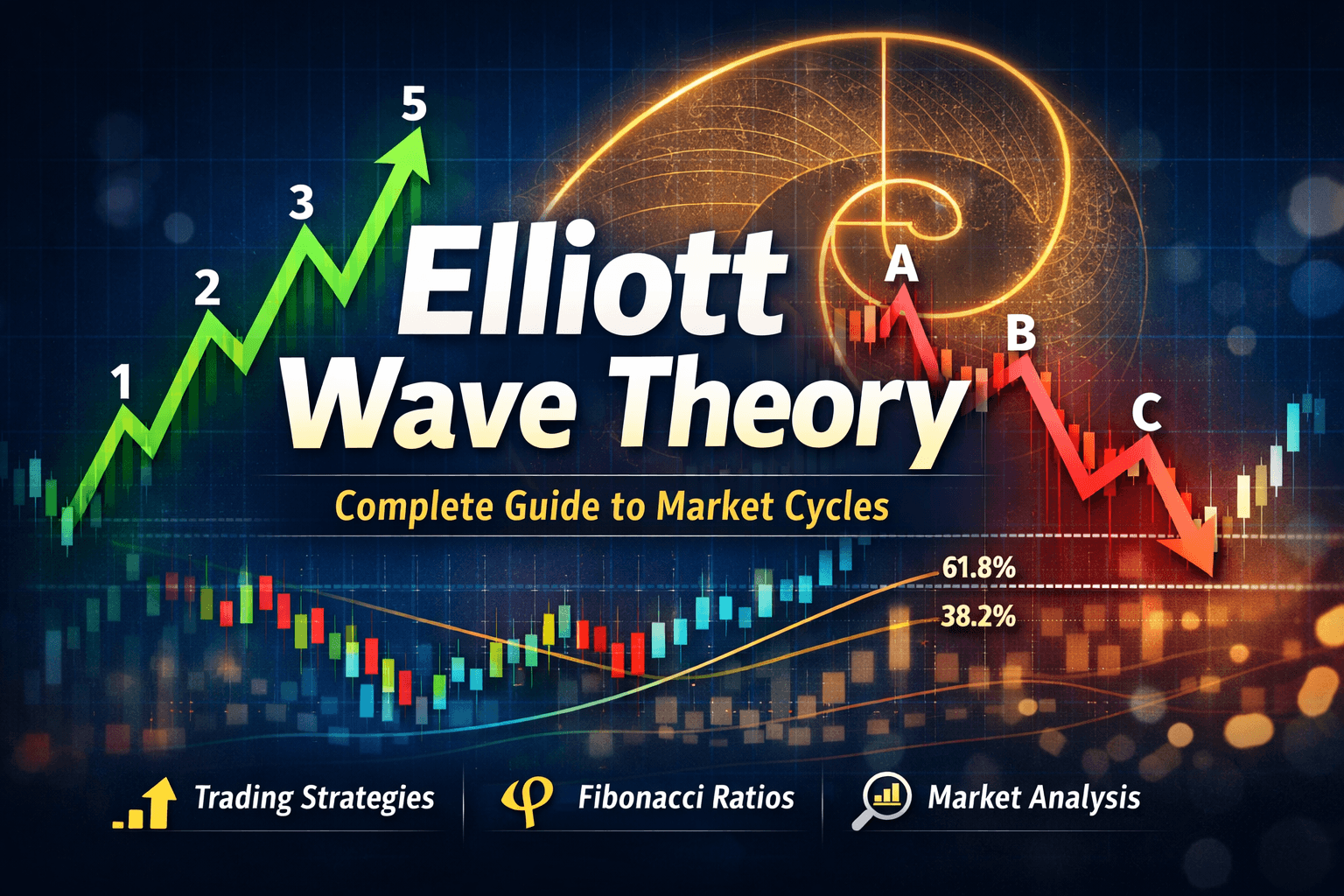
A Complete Guide to Market Cycles 🌊
Financial markets don’t move randomly. They move in patterns shaped by human psychology. Elliott Wave Theory helps traders and investors understand these patterns and anticipate what comes next.
This guide breaks down Elliott Wave Theory into clear, practical concepts—from wave structure and core rules to Fibonacci relationships and real-world applications.
🔍 Overview
Elliott Wave Theory, developed by Ralph Nelson Elliott in the 1930s, is a method of technical analysis that identifies repeating price patterns driven by collective investor psychology.
Elliott observed that market trends unfold in recognizable waves across all timeframes—from minutes to decades—and that these waves often follow mathematical relationships based on Fibonacci ratios.
🎯 Key Principles
📊 Markets move in waves driven by investor psychology
🔄 Patterns repeat across timeframes (fractal nature)
🌀 Fibonacci ratios govern wave relationships
🌍 Applicable to any freely traded market
🏗️ Basic Wave Structure
🚀 Impulse Waves (5-Wave Pattern)
Markets trend in five waves in the direction of the dominant trend:
1 → 2 → 3 → 4 → 5
🔥 Waves 1, 3, and 5 (Impulse)
Move in the direction of the trend
Represent strong price expansion
Wave 3 is usually the strongest and longest
🔄 Waves 2 and 4 (Corrective)
Move against the trend
Act as temporary pullbacks
Never fully retrace the prior impulse wave
📉 Corrective Waves (3-Wave Pattern)
After a 5-wave impulse, markets correct in three waves:
A → B → C
Common Corrective Patterns
⚡ Zigzag (5-3-5): Sharp correction
📏 Flat (3-3-5): Sideways consolidation
🔺 Triangle (3-3-3-3-3): Contracting volatility
🌀 Complex Corrections: Combinations of the above
📏 Core Elliott Wave Rules (Never Broken)
These rules define whether a wave count is valid:
📜 Rule 1: Wave 2 Never Retraces 100% of Wave 1
Wave 2 must not move beyond the start of Wave 1.
📜 Rule 2: Wave 3 Is Never the Shortest
Among waves 1, 3, and 5, Wave 3 cannot be the smallest.
📜 Rule 3: Wave 4 Never Overlaps Wave 1
In impulse waves, Wave 4 cannot enter Wave 1’s price territory.
📋 Wave Guidelines (High-Probability Tendencies)
These are not rules, but commonly observed behaviors.
Wave 2 Characteristics
Retraces 50%–78.6% of Wave 1
Often sharp and fast
Commonly a zigzag
Wave 3 Characteristics
Extends 161.8% of Wave 1
Strongest momentum and volume
Rarely subtle
Wave 4 Characteristics
Retraces 23.6%–50% of Wave 3
Often sideways or complex
Alternates in structure with Wave 2
Wave 5 Characteristics
Often equals Wave 1
May show momentum divergence
Can be extended or truncated
🔄 Alternation Principle
Markets like balance:
If Wave 2 is simple, Wave 4 tends to be complex
If Wave 2 is deep, Wave 4 tends to be shallow
⚡ Special Patterns & Exceptions
🚀 Wave Extensions
One impulse wave (1, 3, or 5) usually extends significantly.
Most commonly, Wave 3 extends.
✂️ Truncated Fifth
Wave 5 fails to exceed Wave 3—often signaling trend exhaustion.
📐 Diagonal Patterns
Leading Diagonal: Appears in Wave 1 or A
Ending Diagonal: Appears in Wave 5 or C
Both have overlapping structures.
🌀 Fibonacci Relationships
Fibonacci ratios are central to Elliott Wave projections.
Ratio | Percentage | Common Use |
|---|---|---|
1.618 | 161.8% | Wave 3 target |
0.618 | 61.8% | Retracements |
2.618 | 261.8% | Extended waves |
0.382 | 38.2% | Shallow pullbacks |
0.236 | 23.6% | Minor retracements |
Common Relationships
Wave 3 ≈ 161.8% of Wave 1
Wave 5 ≈ 100% of Wave 1
Wave 2 ≈ 61.8% retracement
Wave 4 ≈ 38.2% retracement
💼 Practical Applications
Elliott Wave Theory works across markets:
📈 Stocks & indices
💱 Forex pairs
🛢️ Commodities
₿ Cryptocurrencies
Trading Use-Cases
Entries
End of Wave 2 → Wave 3
End of Wave 4 → Wave 5
Risk Management
Stops beyond invalidation levels
Fibonacci-based targets
Position sizing based on confidence
⚠️ Limitations to Remember
Wave counting is subjective
Multiple valid interpretations exist
Requires experience and screen time
Works best in trending markets
Always combine with other tools
Final Thoughts
Elliott Wave Theory isn’t about prediction—it’s about probability and structure. When used with discipline, it offers a powerful lens to understand market behavior and align trades with crowd psychology rather than emotion.
Educational content only. Not financial advice.